
Published | Last updated
CBSE Class 10 board exam preparation requires a structured daily study plan, thorough understanding of NCERT textbooks, regular practice with sample papers and previous years’ questions, subject-wise preparation strategies, and consistent revision. Students who start early, follow a timetable and practise under exam conditions score better than those who rely on last-minute studying.
CBSE Class 10 board exams test five subjects across a syllabus that takes 10 months of classroom instruction to cover. The students who score well are not always the ones who study the most hours; they are the ones who study the right material in the right sequence, practise regularly and revise systematically.
This guide covers CBSE board exam preparation tips that work across all subjects: how to plan daily study, what to prioritise in each subject, how to use sample papers effectively and what mistakes to avoid during preparation.
1. Understand the CBSE Class 10 Exam Pattern and Syllabus
Before starting preparation, download the latest CBSE Class 10 syllabus from the CBSE Academic website. The syllabus lists chapter-wise weightage, deleted topics, internal assessment components and the question paper design for each subject.
CBSE Class 10 papers include multiple-choice questions (MCQs), short-answer questions (2 to 3 marks), long-answer questions (5 marks) and case-based or competency-based questions. Each subject has a different distribution. For example, Mathematics allocates the highest marks to Algebra and Geometry, while Science distributes marks roughly equally across Physics, Chemistry and Biology.
Understanding this weightage helps students allocate study time proportionally. A chapter worth 15 marks deserves more preparation time than a chapter worth 5 marks.
2. Create a Study Timetable and Prioritise NCERT Textbooks
A realistic daily timetable prevents two common problems: spending too much time on comfortable subjects while ignoring difficult ones, and studying without a plan. Here is a sample weekday study schedule for a Class 10 student:
| Time Slot | Activity | Duration |
| 4:00 PM to 5:30 PM | Subject 1 (weakest subject of the day) | 90 minutes |
| 5:30 PM to 5:45 PM | Break | 15 minutes |
| 5:45 PM to 7:00 PM | Subject 2 (Mathematics or Science practice) | 75 minutes |
| 7:00 PM to 7:30 PM | Break, snack, physical activity | 30 minutes |
| 7:30 PM to 8:30 PM | Subject 3 or revision of the day’s school lessons | 60 minutes |
| 8:30 PM to 9:00 PM | Quick revision of notes, formulas or definitions | 30 minutes |
NCERT textbooks are the primary source for CBSE board exam preparation. Over 90% of board exam questions come directly from NCERT content, exercises and examples. Complete every exercise question, every solved example and every in-text question before opening a reference book. Make short notes of important formulas, definitions and diagrams as you study each chapter.
3. CBSE Board Exam Preparation Tips for Every Subject
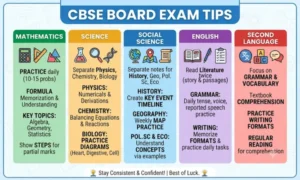
Mathematics: Practice is the only method that works. Solve 10 to 15 problems daily from the chapter you are studying. Memorise all formulas but also understand the steps behind each one. Focus on Algebra (polynomials, quadratic equations), Geometry (triangles, circles) and Statistics, which carry the highest marks. Show all calculation steps in the exam; partial marks are awarded for correct working even if the final answer is wrong.
Science: Treat Physics, Chemistry and Biology as three separate subjects. For Physics, solve numerical problems and understand derivations. For Chemistry, practise balancing equations and memorise reaction types. For Biology, draw and label diagrams (the human heart, the digestive system, plant cell) repeatedly until you can reproduce them from memory. CBSE frequently asks diagram-based questions worth 3 to 5 marks.
Social Science: Make separate notes for History, Geography, Political Science and Economics. For History, prepare a timeline of key events with dates. For Geography, practise map work weekly; map questions carry fixed marks. For Political Science and Economics, understand concepts through examples rather than memorising textbook paragraphs.
English: Read the literature chapters twice: once for the story, once for important passages and answers. For grammar, practise tense, voice, reported speech and clause exercises daily. For writing (letter, notice, article, paragraph), memorise the format and practise one writing task per day.
Second Language: Focus on grammar rules, vocabulary, textbook comprehension and writing formats. Regular reading of the textbook helps with comprehension passages.
4. Practise Previous Years’ Question Papers and Sample Papers
Solving previous years’ papers is the single most effective revision method after completing the syllabus. It shows the actual question patterns, the marks distribution and the types of questions that repeat across years.
- Start solving previous years’ papers at least two months before the exam.
- Solve each paper within the actual exam time (3 hours for most subjects).
- After completing a paper, check answers against the CBSE marking scheme, not just answer keys.
- Track which questions you get wrong repeatedly; those are your weak areas.
- Download the latest CBSE sample papers from the CBSE official site. Solve at least 5 previous years’ papers and 3 sample papers per subject.
Competency-based questions (case study, assertion-reasoning, source-based) have increased in recent years. Practise these specifically; they test application, not memorisation.
5. Build a Revision System and Improve Answer-Writing Skills
Revision without a system is rereading without retention. Use this approach:
- Prepare one-page summary notes for each chapter: formulas, definitions, diagrams and key facts.
- Revise completed chapters weekly. Use a rotation: Monday for Maths chapters, Tuesday for Science, and so on.
- In the last month before exams, increase revision frequency to daily for all subjects.
- Use flashcards or charts on the wall for formulas and dates you forget repeatedly.
Answer-writing skills matter as much as subject knowledge. Read each question carefully. Allocate time per question based on marks: roughly 1 minute per mark. Write in points for 3-mark and 5-mark answers; use numbered steps for Mathematics. Draw diagrams wherever relevant; labelled diagrams score marks even when the written answer is incomplete. Keep 15 minutes at the end of each exam to review your answer sheet.
Admission Enquiry
Nursery to Class 10, with hostel facilities from Class 4. Tell us a little about your child and we will call you back.
Thank you. Your enquiry has been received.
A member of our admissions team will call you shortly. If you need us sooner, call +91 89707 97028 or message us on WhatsApp.
6. Avoid Common Mistakes and Manage Exam Stress
Mistakes that cost marks: Starting serious preparation only in January or February. Ignoring subjects or chapters that feel difficult instead of spending extra time on them. Memorising answers from guidebooks without understanding the concept. Skipping the NCERT exercises and jumping to reference books. Not practising sample papers under timed conditions. Using a mobile phone during study hours.
Managing stress: Board exams feel high-stakes, but stress reduces the ability to think clearly. Sleep 7 to 8 hours every night; cutting sleep to study more is counterproductive. Continue one physical activity, even a 20-minute walk, every day. Take a 10 to 15-minute break every 45 to 60 minutes during study. Talk to a parent or teacher if the pressure feels unmanageable. CBSE board preparation is a marathon across 10 months, not a sprint in the final weeks.
7. How Proper Academic Guidance Helps Class 10 Students
Students who receive structured academic guidance from experienced teachers perform more consistently than those who prepare entirely on their own. Regular assessments, doubt-clearing sessions, subject-specific feedback and a disciplined study environment make a measurable difference in board exam outcomes.
Bright Horizon International School in Karimanelu, Dakshina Kannada, follows the CBSE curriculum with a focus on building strong academic foundations from the primary level. The school’s academic programme includes smart classrooms, science and computer laboratories, a library with digital resources, and foundation-level preparation for NEET, JEE and other entrance exams. The campus facilities include supervised hostels for students from Class 4 to 10, with structured study hours and regular assessments.
Parents exploring CBSE schools with integrated academic support can compare the available programmes, faculty experience and campus infrastructure before making a decision.
Conclusion
CBSE Class 10 board exam preparation comes down to three principles: start early, follow a structured plan and practise under exam conditions. Understand the syllabus and marking scheme. Complete NCERT before any reference book. Practise previous years’ papers and CBSE sample papers with a timer. Revise weekly, not just before exams. Write answers the way the marking scheme rewards them.
The students who score well in Class 10 are the ones who prepare consistently across the year, not the ones who panic-study in March. Start today, follow the timetable and trust the process.
Looking for a CBSE School with Strong Academic Support?
Bright Horizon International School offers CBSE education with experienced faculty, smart classrooms, science and computer labs, and supervised hostel facilities. Located in Karimanelu, Dakshina Kannada.
Enquire: Admission Enquiry | Phone: +91 8970797028
Frequently Asked Questions
How many hours should a Class 10 student study daily for board exams?
Four to six hours of focused self-study daily, in addition to school hours, is a practical target for most students. Split the time across two or three subjects, with short breaks every 45 to 60 minutes. Quality of study matters more than the number of hours; understanding one concept thoroughly is better than reading three chapters superficially.
Are NCERT textbooks enough for CBSE Class 10 board exams?
NCERT textbooks cover the entire CBSE syllabus and form the basis of most board exam questions. Complete all exercises, examples and in-text questions before moving to any reference book. For Mathematics and Science, additional practice from sample papers and previous years’ question papers is useful. Reference books supplement NCERT but do not replace it.
When should students start preparing for CBSE Class 10 board exams?
Start structured preparation at the beginning of the academic year. Students who revise each chapter as it is taught in class build a stronger foundation than those who start intensive preparation three to four months before exams. By November, the focus should shift to revision, sample papers and mock tests.
How can students manage exam stress during Class 10 board preparation?
Maintain a regular sleep schedule of 7 to 8 hours. Take 10 to 15 minute breaks between study sessions. Continue one physical activity such as walking, sports or exercise. Avoid comparing preparation progress with classmates. Talk to parents or teachers when feeling overwhelmed. Consistent daily study reduces last-minute panic.
What is the best way to revise for CBSE Class 10 board exams?
Prepare short notes with formulas, definitions and key concepts for each subject. Revise completed chapters weekly. Solve at least 10 previous years’ question papers under timed conditions. After each paper, check answers against the marking scheme and identify repeated mistakes. Increase revision frequency for difficult chapters.
About the Author
Dr. Sharath Gore is the Founder and Chairman of Bright Horizon International School, Karimanelu, Venur, Dakshina Kannada. A recipient of the Karnataka Shikshana Ratna award, his educational philosophy emphasises building confidence, values and curiosity alongside academic excellence.