
Part of our guide to school admissions at Bright Horizon.
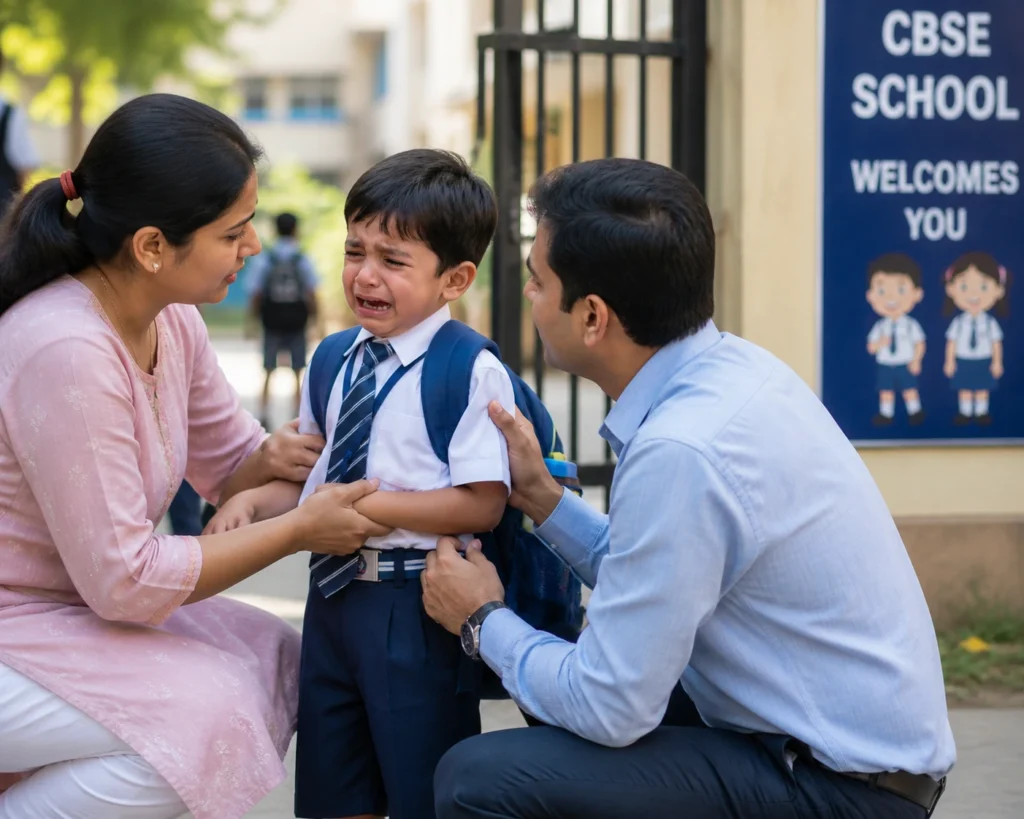
| Quick Answer — First day of CBSE school preparation is the 10–14 day process of adjusting a child’s sleep routine, building basic independence skills, visiting the school campus, and using specific language about the school day — so that the child arrives familiar, not anxious. Done consistently, this preparation reduces separation distress from a 3–4 week window to 5–10 school days. |
The First Day of CBSE School is not just a logistical event. It is the opening moment of a child’s relationship with structured learning — and how that moment feels shapes attendance, engagement, and confidence well into the primary years.
The preparation gap in India is well-defined: most families buy the uniform, pack the bag, and arrive at the gate. The developmental work — sleep scheduling, social script practice, emotional vocabulary building — receives far less attention. That gap is where most first-day anxiety concentrates, and it is entirely closable.
Understanding the CBSE School Environment
CBSE — the Central Board of Secondary Education — governs curriculum and assessment standards for its affiliated schools across India and abroad. For early classes, CBSE’s National Curriculum Framework (NCF) prioritises activity-based learning, conceptual understanding, and holistic development rather than rote drill or memorisation. The CBSE learning approach in nursery and kindergarten years is deliberately movement-integrated: circle time, story-based instruction, creative play, and structured free exploration form the daily rhythm — not extended desk work.
For parents enrolling children at a CBSE school in Mangalore or elsewhere along the Karnataka coast, this distinction matters practically. Schools affiliated with CBSE in the Dakshina Kannada and Udupi districts follow the same NCF framework as schools in Bengaluru or Delhi — meaning the content your child encounters in Class 1 at a school in Mangalore is structurally equivalent to any other CBSE school nationally. What varies is school culture, language of instruction (English, Kannada, or Tulu as a third language option in some coastal schools), and the specific extracurricular and settling programmes each school runs in the first weeks of term. For guidance on the full CBSE school environment and what activities your child can expect, “explore how Bright Horizon structures its early-year curriculum“.
Understanding this environment removes one of the most common parental anxieties: the fear that a 4-year-old will not be able to keep up. The CBSE curriculum for early classes is built around the developmental reality of 3–6 year olds, not against it.
Why the First Day of CBSE School Is a Genuine Transition Event
The move from home or informal play-school to a CBSE-affiliated school introduces several simultaneous changes: a fixed daily schedule, peer interaction with unfamiliar children, adult authority figures who are not family members, and physical spaces that are entirely new. Each change is manageable in isolation. Faced together, without preparation, they are genuinely overwhelming for a child under 6.
A child first day at CBSE school experience that goes well is not a matter of the child being “ready” by temperament. It is a matter of how systematically the family has reduced unfamiliarity before the first day arrives. Preparation does not eliminate the strangeness — it compresses it into a manageable window.
For a broader picture of how a well-structured CBSE school supports this transition through its “facilities, sports, and activity programmes”, the physical and extracurricular environment plays a significant role in how quickly a child feels the school is their place.
Signs Your Child May Be Nervous About School
First-day school anxiety in India rarely arrives with a clear label. Parents observing these patterns in the days before the term begins should address them directly rather than assuming they will resolve on the morning itself:
- Stomach aches or headaches appearing consistently on school mornings with no medical cause
- Sleep disturbance — difficulty falling asleep, night waking, or distressing dreams about school
- Regression in behaviours that had previously resolved — thumb-sucking, bedwetting, or intense clinginess
- Repetitive questioning about whether the parent will return, who will be at school, and what will happen
- Unusual quiet or avoidance when school is mentioned in conversation
These are normal responses to an unfamiliar significant event, not signs of developmental difficulty. The correct response is acknowledgement and structured preparation — not minimisation, and not extended reassurance conversations that can inadvertently amplify the anxiety by signalling that the concern is justified.
When to Start and How to Structure Your Preparation
Start the Sleep and Schedule Shift 10–14 Days Before School
Most children on school holidays develop sleep patterns incompatible with a 6:30–7 am school-morning wake-up. Shifting bedtime earlier by 15 minutes every two days in the fortnight before term begins means the child’s body clock arrives at Day 1 already adjusted. Align meal timings too: if the school tiffin break is at 10:30 am and lunch is at 12:30 pm, practise those slots at home the week before. A hungry child during a classroom transition is a distressed child — and hunger is entirely preventable with timing practice.
What should you say — and not say — when describing school?
Use specific, observable language rather than evaluative claims. “You’ll love it” sets an expectation that can feel like a betrayal if Day 1 is hard. “After morning circle, you’ll have snack time, and at 3:15 pm I’ll be at the gate” is a sequence the child can hold onto. Name the teacher if you know it. Name a classroom item you saw on the orientation visit. The more the school day resembles a known story rather than an unexplored territory, the smaller its emotional footprint on the first morning.
Creating Positive Expectations Without Overpromising
Frame school as a place of things the child will be able to do, not things they will have to endure. “You’ll learn a new rhyme,” “You’ll get to use the big crayons,” “Your teacher does story time after lunch.” This language builds anticipation rather than apprehension. Read school-themed picture books in the final week. For younger children, role-play arrival, circle time, and pickup using toys — the physical enactment of routine builds neural familiarity faster than conversation alone.
CBSE School Readiness: 5 Practical Preparation Steps
1. Build a Morning Routine That Runs on Its Own
A school morning routine written on a chart — wake, wash, dress, breakfast, bag check, shoes — removes parent-child negotiation from the highest-stress moment of the day. Put the chart where the child can see it and let the chart give the instructions. Children who follow a visual sequence independently arrive at school with their regulatory capacity intact, rather than depleted by a 45-minute argument about shoes.
2. Does visiting the school campus actually help? Yes — here’s why
CBSE school readiness research is consistent on this point: familiarity with the physical space directly lowers the novelty-triggered stress response on Day 1. Many CBSE-affiliated schools in Mangalore and across Karnataka offer orientation sessions before the term starts. If a formal visit is not available, walk past the school, show the gate, and identify the play area. A child who has stood in the school courtyard once enters on Day 1 with a spatial memory to anchor them — not a blank unknown.
3. Practise the 6 Independence Skills That Matter Most on Day 1
Identify every task the child will need to manage without adult help: putting on and fastening shoes, opening the tiffin box, drinking from their water bottle independently, using a school toilet, saying their name clearly to a teacher, and returning belongings to their bag. Practise each one at home. Independence in small physical tasks produces disproportionate confidence in new environments — a child who opens their own lunch box doesn’t need to ask for help, and that one moment of capability anchors the entire morning.
4. What three phrases should every school-starter know?
Give your child three social scripts before Day 1: how to introduce themselves (“My name is ___, what’s yours?”), how to ask for something (“Can I please have ___?”), and how to get a teacher’s attention (“Excuse me, ___”). These three scripts remove the paralysis that comes from not knowing how to initiate interaction in a structured setting. Pair the language practice with unstructured park play or playdates with unfamiliar children where the scripts can be tested in a lower-stakes setting.
5. Describe CBSE Classroom Activities So They Sound Familiar
Children who walk into a CBSE classroom already knowing what circle time, morning assembly, and activity corners involve participate — those who encounter these concepts for the first time watch anxiously instead. Describe them specifically in the days before school. Show images from the school’s orientation materials or website. For kindergarten CBSE preparation, a week of kitchen-table role-play — colouring on cue, passing items to “classmates” (soft toys), sitting in a circle — compresses weeks of classroom acclimatisation into a few days.
Prepared vs. Unprepared: The Measurable Difference on Day 1
The table below reflects observable outcome patterns documented consistently by school counsellors and child development specialists working with CBSE-affiliated schools in urban and semi-urban India. The preparation variable is the single most significant factor in first-week settling, above gender, birth order, or prior nursery school attendance.
| Dimension | Prepared Child (Routine set 10–14 days prior) | Unprepared Child (No prior routine) |
| Sleep cycle | Adjusted to 9–10 pm bedtime; wakes without resistance | Irregular sleep; morning wake-up becomes a conflict |
| Morning energy | Calm, eats breakfast, arrives school alert | Rushed, skips breakfast, arrives anxious or tearful |
| Separation moment | Goodbye is brief; child walks in independently | Clinging, crying, parent reluctant to leave |
| Classroom settling | Sits within 10–15 minutes; engages with activity | Disruptive for 30–45 min; needs constant teacher reassurance |
| End-of-day mood | Shares stories, asks to return tomorrow | Withdrawn, refuses to talk, sleep disrupted |
| Week 2 attendance | Consistent; anxiety window closes within 5–7 school days | Irregular; anxiety can extend to 3–4 weeks |
| Parent stress level | Low — parent confident in child’s readiness | High — parent second-guesses school choice |
The preparation gap is not about academic ability or a child’s temperament — it is about how much unfamiliarity has been made familiar before the first step through the gate.
Emotional Preparation: The Part Most Parents Skip
Reducing First-Day School Anxiety Before It Peaks
The most effective anxiety reduction technique is specific preparation, not general reassurance. Walk through the school day hour by hour with your child the evening before: “At 8 am you go in with your teacher. At 10 am it’s snack time. At 12:30 pm it’s lunch. At 3:15 pm I’m at the gate.” Children with first-day anxiety are calmed by sequence and the evidence that the parent knows exactly where they will be throughout the day. Vague reassurances — “You’ll be fine,” “Don’t worry” — leave the unknown intact.
How to Reduce Separation Anxiety in Kids at School Entry
How to reduce separation anxiety in kids at school entry runs counter to parental instinct. The most helpful thing a parent can do is leave promptly after a brief, warm goodbye. Prolonged departures — negotiating at the gate, returning after saying goodbye, hovering near the classroom window — signal to the child that the parent is also uncertain the school is safe. The child’s nervous system follows the parent’s signal. A 90-second goodbye that includes a pre-agreed ritual (three squeezes, a specific wave, a family phrase) and then a confident departure is more soothing than ten minutes of loving uncertainty.
Children whose parents remain visibly anxious at drop-off can take three or more weeks to reach the same settled baseline.
Building Confidence and Curiosity Through the First Weeks
Confidence in a new environment is built through small, repeated successes. In the evenings, ask specific questions rather than open evaluations: “What was one thing that surprised you today?” or “Who did you sit near at snack time?” These questions access episodic memory and position school as a place of discovery rather than performance. Avoid “How was school?” — it reliably produces “Fine.”
For a closer look at how “Bright Horizon approaches emotional readiness and confidence building in its early learning programme“, the school’s activity-based settling strategy for new students in Term 1 directly addresses the transition period.
CBSE School First Day Checklist for Parents
Pack the bag the evening before Day 1, with your child alongside you — the act of packing together builds ownership and reduces morning chaos. This CBSE school checklist for parents covers all five preparation categories. Items marked with a checkbox should be physically ticked off the night before school.
| School Bag Essentials | |
| ☐ | Water bottle (labelled with child’s name) |
| ☐ | Tiffin / lunch box (labelled) |
| ☐ | Spare uniform or inner wear |
| ☐ | Small hand towel |
| ☐ | Hand sanitiser |
| CBSE Books & Stationery | |
| ☐ | NCERT textbooks as per school list (Class 1+) |
| ☐ | Pencils, eraser, sharpener (LKG/UKG) |
| ☐ | Crayon set or colour pencils |
| ☐ | Pencil pouch / zipper bag |
| ☐ | Notebook or drawing book as specified |
| Identity & Uniform | |
| ☐ | Full school uniform, ironed the night before |
| ☐ | ID card or student badge |
| ☐ | School shoes and socks — broken in before Day 1 |
| ☐ | Name tags on all clothing and accessories |
| Health & Hygiene | |
| ☐ | Prescribed medication with nurse permission letter if required |
| ☐ | Tissues or handkerchief |
| ☐ | Emergency contact card inside school bag |
| ☐ | Sunscreen if school has outdoor activity periods |
| Emotional Readiness Items | |
| ☐ | A small comfort object permitted by school (nursery / kindergarten) |
| ☐ | Pre-agreed goodbye signal — hug, wave, or phrase |
| ☐ | A handwritten note from parent if child can read simple words |
One item not on the list but worth preparing: a brief written note to the class teacher outlining any known anxiety triggers, food allergies, or settling strategies that work for your child. Teachers at CBSE schools appreciate the context — it allows them to position your child near a calm peer or near the teacher’s sight line during the first few days.
What to Do on the First Day: A Parent’s Action Plan
Keep the Goodbye Under 90 Seconds
The goodbye is the highest-stakes moment of the first day. Execute it with warmth, specificity (“I’ll be at the gate at 3:15”), physical contact, and no visible hesitation. Then leave. Every additional minute added to the departure typically extends, not eases, the separation distress. If the school has a first-day protocol or buddy teacher system, let that system do its work — it is designed precisely for this transition moment.
Managing Your Own Emotional Response
Children under 7 are extraordinarily sensitive to parental emotional states. A parent who cries at the gate, calls the school before 10 am, or hovers near the classroom window communicates anxiety — and an anxious child is not available for learning. Prepare your own response to the goodbye as deliberately as you prepare your child’s. Have a plan for the hour after drop-off: coffee with another parent, a walk, a work task that requires focus. The transition is yours as well as your child’s.
Building a Positive Memory After School
Plan something specific for after school: a preferred snack, a short walk, or a quiet activity your child enjoys. This provides a reliable reward structure for the day’s effort and signals that school is a contained event with a good ending. Avoid interrogating the school day immediately — allow 20–30 minutes of decompression first. Open-ended, specific questions produce the best conversation: “Tell me something that made you laugh” or “What was the strangest thing you saw today?”
Common Mistakes to Avoid in the First Month
- Comparing your child’s adjustment timeline to a sibling’s, a friend’s child’s, or a neighbourhood standard. Every child’s anxiety window is their own.
- Removing the child from school after a difficult first week. Consistency in the first month is the single most reliable pathway to adjustment — withdrawal resets the anxiety clock entirely.
- Overloading the child with instructions on the morning of Day 1. One or two reminders maximum — the rest should already be habitual from the preparation period.
- Ignoring emotional signals in the days before school. Addressed early, pre-school anxiety is manageable. Left unacknowledged, it typically peaks on Day 1 rather than resolving.
- Over-promising enjoyment. “You’ll absolutely love it” sets an expectation that functions as a broken promise if the day is hard. “It might feel strange at first, and strange feelings go away” is both accurate and reassuring.
After School: Supporting Adjustment Through the First Weeks
The after-school environment is as important as the morning preparation. A consistent post-school routine — snack at the same time, decompression before homework, same dinner and bedtime — signals that school is an addition to the day’s structure, not a disruption of it.
Watch for sustained distress beyond week two. Brief upset at drop-off that resolves within 10–15 minutes of the parent leaving is developmentally normal. Persistent, escalating distress at or after week two — or physical symptoms appearing consistently on school mornings — warrants a direct conversation with the class teacher. CBSE schools are required to have a designated counselling resource; if distress is significant, request a referral.
For parents with children in early classes, the “CBSE admission process and school readiness guidance” page outlines how the school supports new families through the first term — including the parent orientation sessions scheduled before each academic year.
Long-Term Benefits of Getting the First Day Right
A child who transitions smoothly into a CBSE school environment establishes school connectedness — one of the most reliably predictive factors for attendance, academic engagement, and graduation outcomes identified in Indian education research. This connection does not emerge from academic performance; it emerges from feeling safe, known, and capable in the school environment. Early preparation is the mechanism that makes those feelings available from Day 1.
The holistic development in CBSE schools — social confidence, creative curiosity, physical coordination, emotional resilience — only reaches its full potential when children arrive psychologically prepared for the environment. For parents choosing between CBSE schools in Mangalore for their child’s nursery or kindergarten admission, one of the most revealing questions to ask during a school visit is: “What is your settling-in protocol for new students in the first two weeks?” How a school answers reveals its culture far more accurately than any prospectus.
Frequently Asked Questions
How do I prepare my child for a CBSE school?
Start 10–14 days before the first day. Shift your child’s sleep and wake cycle to match school timings, practise basic independence skills including dressing and opening a tiffin box, visit the school campus at least once, and describe the school day in specific, concrete terms. Children respond better to named routines and observable predictions than to vague reassurance.
What is the CBSE curriculum for early classes?
For Nursery, LKG, and UKG, CBSE schools follow an activity-based learning approach focused on language development, number sense, motor skills, and social interaction — not rote learning or extended desk time. From Class 1 onwards, NCERT textbooks are introduced, with CBSE’s National Curriculum Framework guiding a concept-centred, child-led approach across all subjects.
How can I reduce my child’s school anxiety?
Keep goodbyes brief, warm, and consistent — a prolonged departure signals uncertainty rather than safety and extends rather than eases separation distress. Role-play the school day at home so the environment feels familiar before Day 1. Validate your child’s feelings without amplifying them. Maintain a consistent after-school routine: snack, calm conversation, and a predictable bedtime all signal stability.
What should I pack on the first day of CBSE school?
Pack a labelled water bottle, labelled tiffin box, spare clothing, a hand towel, the full school uniform with ID card, school-specified stationery, and an emergency contact card inside the bag. For nursery and kindergarten children, check with the school whether a small comfort item is permitted during the first week.
How long does it take for a child to adjust to school?
For children prepared with a structured pre-school routine, the adjustment window is typically 5–10 school days. Without prior preparation, adjustment commonly extends to 3–4 weeks. The key factors that shorten the window are a stable morning routine established before term starts, a parent who departs calmly and promptly, and a school that uses activity-based settling strategies in the first week.
First day of CBSE school preparation is a 10–14 day investment that pays in weeks of smoother settling. The parents who do this work do not arrive at the gate hoping for the best — they arrive having already made the unfamiliar familiar. For children, that difference is measurable in how quickly the classroom becomes their place. For parents, it is measurable in how confidently they walk away from the gate on Day 1 — which is, in every school counsellor’s experience, the single most important variable in how the morning goes.
For reference on CBSE’s foundational learning guidelines for early classes, the CBSE Academic portal (cbseacademic.nic.in) publishes the complete National Curriculum Framework and activity-based learning resources for all affiliated schools including those in Mangalore.