
Part of our guide to student life and activities at Bright Horizon.
Science lab activities at Bright Horizon give students a direct, hands-on connection to concepts that would otherwise stay confined to a textbook page. Reading about a chemical reaction and watching one actually happen are two different kinds of learning, and most students remember the second far longer than the first, which is exactly why practical lab work sits alongside classroom teaching rather than as an occasional add-on.
Reading about a chemical reaction and watching one actually happen are two different kinds of learning, and most students remember the second far longer than the first. Practical science education gives students that second kind of learning: a chance to observe, test, and question rather than only memories. Well-designed science experiments for school students, at Bright Horizon and elsewhere, are what turn hands-on science learning from a nice idea into an actual habit. At Bright Horizon International School in Venur, science lab activities are built directly into how Physics, Chemistry, and Biology are taught, alongside the school’s Computer Science labs, giving CBSE students hands-on exploration alongside classroom instruction rather than instead of it. This article looks at why practical science learning matters, what students actually gain from it, how it connects to CBSE learning and future competitive exams, and what parents should look for when evaluating a school’s science programme.
Why Science Experiments Are Important for School Students
Theoretical learning explains what should happen; practical learning lets a student see whether it actually does, and that gap between reading a concept and observing it is where real understanding tends to form. A student who reads that a chemical reaction produces heat understands the sentence; a student who feels the test tube warm up understands the concept. Experiments let students observe cause-and-effect directly: change one variable, watch the result change, and the relationship between the two becomes clear in a way a diagram alone rarely achieves. This also tends to make science simply more interesting, since there is a natural curiosity in watching something happen rather than reading that it does. None of this works without proper structure, though. Experiments need to be age-appropriate and conducted under proper teacher supervision, particularly once chemicals, heat, or specimen handling is involved.
Connecting Classroom Concepts With Practical Experiments
Good lab-based learning generally follows a simple sequence: theory taught in class, an experiment that tests or demonstrates that theory, guided observation of what actually happens, and a conclusion the student draws by comparing the observation back to the original concept. This sequence mirrors how NCERT’s own science textbooks are structured, with activities and “try this” sections built directly alongside the theory they support, rather than as a separate add-on. A textbook chapter on the states of matter becomes more concrete when a student watches ice melt and water boil under controlled conditions, timing and measuring rather than just reading a diagram. This sequence improves both conceptual clarity, since the concept was tested rather than just stated, and retention, since a hands-on memory tends to stick longer than a read one. Teachers use this deliberately: an experiment scheduled shortly after a topic is taught reinforces the lesson while it is still fresh, rather than being a disconnected activity weeks later.
Science Lab Activities at Bright Horizon
Science lab activities for CBSE students at Bright Horizon’s campus in Venur run through fully equipped labs for Physics, Chemistry, Biology, and Computer Science, built to support hands-on exploration alongside classroom teaching. Students take part in demonstrations and science experiments at Bright Horizon as a regular part of their science learning, with teachers guiding and supervising each session rather than leaving students to work through activities unsupervised. The intent behind these labs is simple: give students a direct, physical connection to concepts that would otherwise stay confined to a textbook page. See the school’s full facilities overview for more on the campus infrastructure supporting this.
What Students Can Learn Through Science Lab Experiments
The specific activities a class does vary by grade and topic, but a typical CBSE science laboratory generally covers ground across three subjects:
Physics Activities
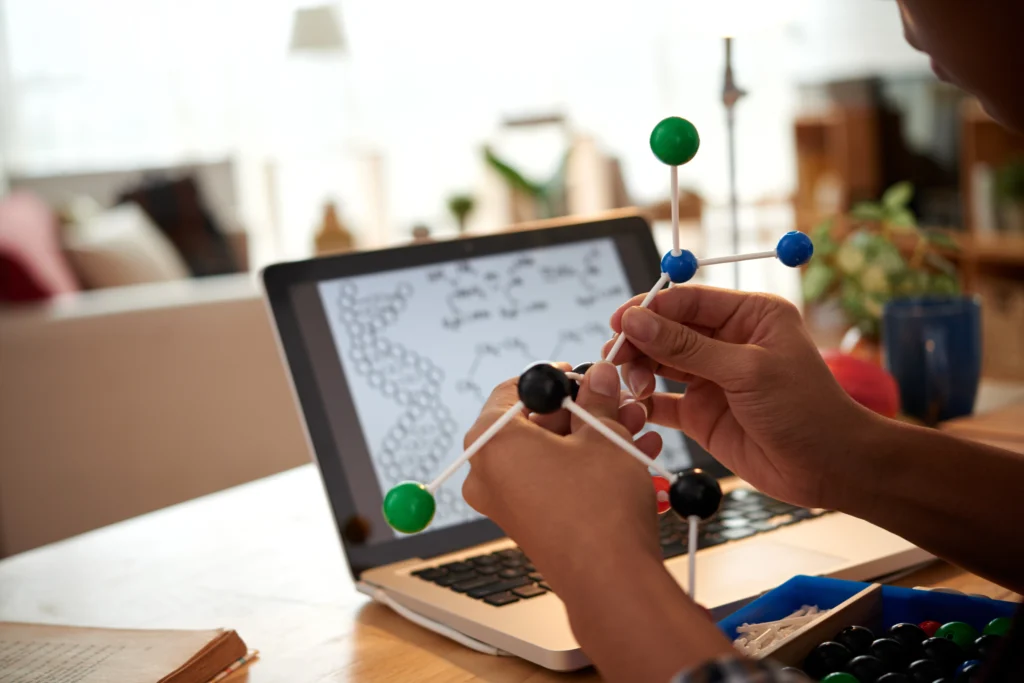
Physics lab work at the school level typically covers concepts like force and motion, light and reflection, simple electrical circuits, and simple machines, activities that let students see a principle in action rather than only calculate it on paper.
Chemistry Activities
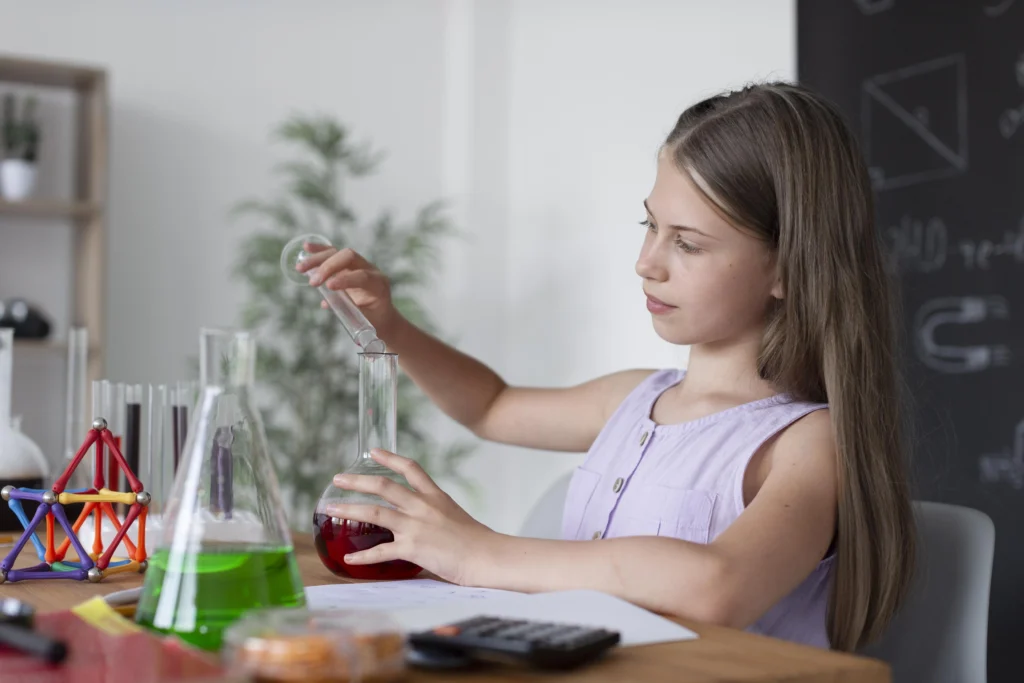
Chemistry activities appropriate for school students generally cover topics like acids and bases, observable chemical reactions, separating mixtures, and the difference between physical and chemical changes, always under direct teacher supervision given the materials involved.
Biology Activities
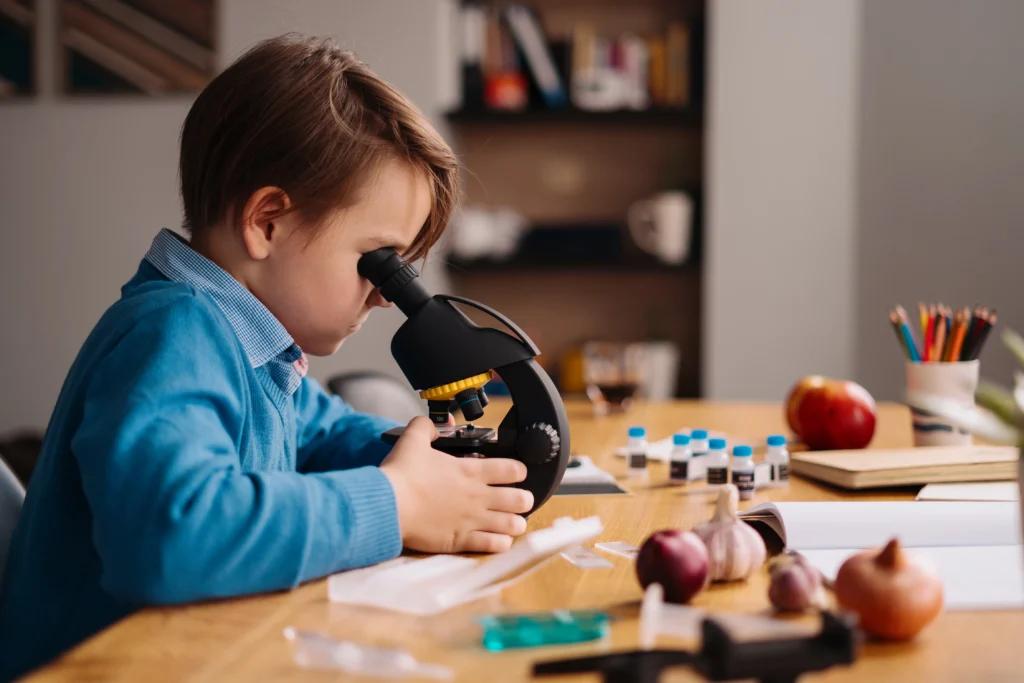
Biology lab work commonly includes studying plant structures, examining prepared specimens, an introduction to cell structure under a microscope, and other age-appropriate topics in human biology, giving students a direct look at concepts usually taught only through diagrams.
5 Skills Students Develop Through Science Lab Activities
Observation Skills
Working directly with materials and instruments trains students to notice small changes, measurements, and patterns they would likely miss reading the same information in a textbook, colour changes, temperature shifts, the exact point a reaction starts.
Critical Thinking
An experiment that does not go quite as expected is often more valuable than one that does, since it pushes a student to ask why, rather than simply accept a result at face value.
Problem-Solving Skills
Lab work regularly puts students in a position where something needs troubleshooting, a measurement that seems off, a setup that is not working, teaching them to identify the actual problem and test a fix rather than guess.
Analytical Skills
Recording observations and comparing results across repeated attempts or between classmates teaches students to look for patterns in data, a skill that transfers directly to how they will later approach any subject requiring evidence-based reasoning.
Scientific Thinking
Forming an idea, testing it through an actual experiment, and drawing a conclusion based on what was observed, rather than what was expected, is the core habit of scientific thinking, and lab work is where students practise it repeatedly rather than just reading about it.
How Teachers Make Science Experiments Meaningful
A teacher’s role in a science lab starts before the experiment itself: explaining the objective and the procedure clearly enough that students understand not just what to do, but why they are doing it. During the activity, supervision covers both safety and learning, correcting a step gone wrong before it becomes a safety issue or a false result, while encouraging students to ask questions rather than simply follow instructions mechanically. After the experiment, the teacher’s job shifts to connecting what was observed back to the classroom concept explicitly, since the link between the two is not always obvious to students without that final step being spelled out.
How Practical Science Learning Benefits CBSE Students
CBSE’s own curriculum design already builds in practical components alongside classroom teaching, and lab-based learning complements this by reinforcing conceptual understanding over rote memorisation, a student who has actually observed a reaction understands it differently than one who has only memorised the equation for it. This tends to improve both engagement, since practical sessions break up a purely lecture-based routine, and retention, for the same reason hands-on memories generally last longer than read ones. Applying a concept in a physical experiment, rather than only in a written answer, is also closer to how that concept will actually be used later, in a lab, a research setting, or any field requiring scientific reasoning. The CBSE curriculum framework itself reflects this emphasis on practical, application-based learning rather than recall alone, a theme covered further across Bright Horizon’s other CBSE education articles.
Does Science Lab Learning Help With Future NEET and JEE Preparation?
Strong fundamentals in Science and Mathematics matter more for NEET and JEE preparation than last-minute revision, since both exams test conceptual application under time pressure, not just recall. Practical lab experience builds exactly this kind of conceptual grounding: a student who has directly observed how a principle behaves is often better equipped to apply it to an unfamiliar problem than one who has only memorised the formula. Curiosity and analytical thinking, both of which lab work actively develops, carry over directly into the kind of reasoning these exams demand. Bright Horizon runs dedicated Medical (NEET), Engineering (IIT-JEE), Civil Services, and CA Foundation coaching starting from Class 5, building on the same conceptual foundation that lab-based learning supports earlier on.
It is worth being direct about one thing: laboratory activities alone do not guarantee success in NEET or JEE. They build a stronger foundation for the reasoning these exams test, but results ultimately depend on sustained study, practice, and the student’s own effort over years, not any single component of their schooling.
Why Parents Should Look for Practical Science Learning in a School
Practical learning in CBSE schools varies more than most parents expect, so when comparing schools, it is worth asking specifically about laboratory facilities, not just whether they exist, but whether students actually use them regularly as part of the curriculum. Ask about teacher supervision during lab sessions, how much of an experiment is done hands-on by students versus demonstrated only by the teacher, and what safety practices are actually followed. Practical learning should complement strong academic instruction, not substitute for it; a school with excellent labs but weak classroom teaching is not necessarily the better choice over one with modest facilities and strong instruction. Experiential learning is one factor worth weighing when comparing schools, but it works best evaluated alongside academics, teacher quality, and the overall learning environment, not in isolation.
Building Curiosity Through Science at Bright Horizon
The point of a science lab in CBSE school settings is not just covering a syllabus topic; done well, it teaches a student to ask their own questions, why did this happen, what would change if I adjusted this, and that habit of curiosity tends to extend well beyond the specific experiment in front of them. At Bright Horizon, hands-on exploration in the Physics, Chemistry, Biology, and Computer Science labs is built into the school’s broader approach of pairing academic instruction with practical, skills-based learning, alongside its coding, AI, and other 21st-century-skills programmes. The goal is simple: give students enough direct contact with how science actually works that curiosity becomes a habit, not just a single class period’s activity.
Frequently Asked Questions
Why are science lab activities important for students?
Science lab activities let students observe scientific principles directly rather than only reading about them, which tends to build clearer understanding and longer-lasting retention than theory alone. They also develop practical skills, observation, critical thinking, and problem-solving, that pure classroom learning does not build in the same way.
How do science experiments improve conceptual understanding?
Experiments let students see cause and effect directly: change a variable, observe the result, and the underlying concept becomes concrete rather than abstract. This direct observation tends to clarify concepts that are harder to grasp from a diagram or a written explanation alone.
What skills do students develop through laboratory activities?
Laboratory activities build observation skills, critical thinking, problem-solving, analytical skills, and scientific reasoning, the habit of forming an idea, testing it, and drawing a conclusion based on evidence rather than assumption.
Are science lab activities useful for CBSE students?
Yes. Practical activities complement CBSE’s classroom-based curriculum by reinforcing conceptual understanding over rote memorisation, and tend to improve both engagement and retention compared to lecture-only learning.
Can practical science learning support NEET and JEE preparation?
Practical science learning builds the conceptual grounding and analytical thinking both exams test, which supports preparation, but it does not by itself guarantee success. NEET and JEE results depend on sustained study and practice over time, not any single part of a student’s schooling.
How does Bright Horizon provide practical science learning?
Bright Horizon’s campus includes fully equipped labs for Physics, Chemistry, Biology, and Computer Science, where students take part in demonstrations and experiments under teacher supervision as a regular part of their science education, alongside the school’s broader focus on skills like coding and AI.
Explore Practical Learning at Bright Horizon
Give your child an opportunity to learn science beyond textbooks. Explore the practical learning environment at Bright Horizon International School and discover how hands-on education can build strong foundations for the future.