
Part of our guide to student life and activities at Bright Horizon.
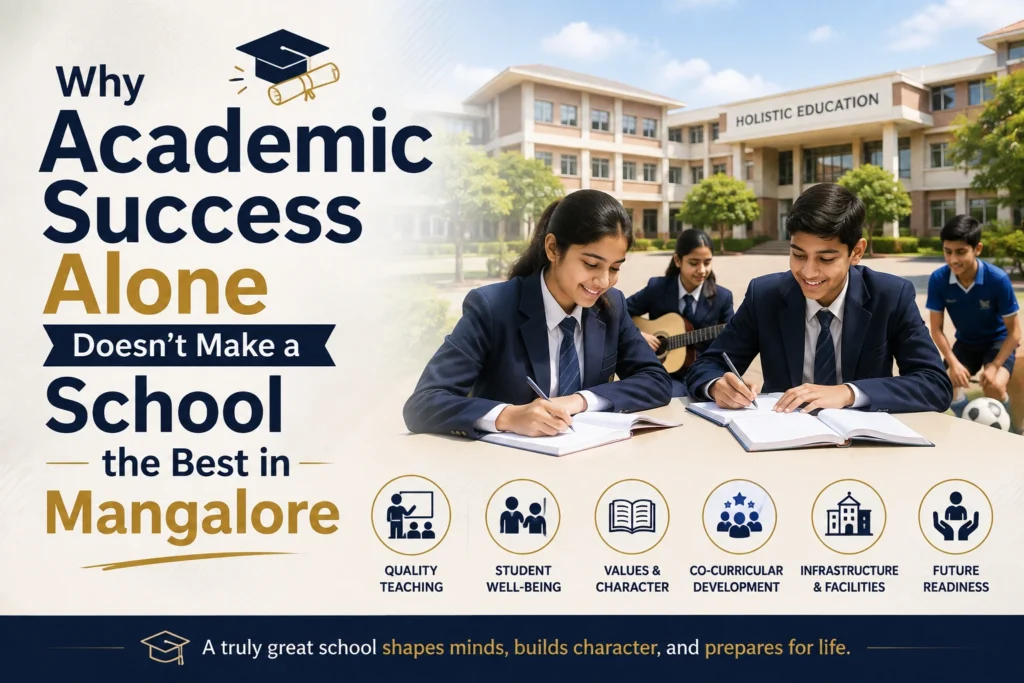
Knowing how to choose the best school in Mangalore means looking past exam results alone. Board scores tell you how students perform on a test, not whether they can communicate confidently, solve problems independently, or handle setbacks. Teaching quality, infrastructure, safety, sports, co-curricular activities and student support all shape the same child’s development, and the right school for one family may not be right for another.
Every year, admission season in Mangalore brings the same question to parent WhatsApp groups and school-gate conversations: which school gets the best board results? It’s a fair question, but it’s an incomplete one. A school’s Class 10 pass percentage says nothing about whether a shy child gets called on in class, whether a struggling student gets extra support before they fall behind, or whether a school’s labs and playgrounds actually get used or just photographed for the prospectus. Anyone evaluating school education in Mangalore is increasingly asking a second question alongside the first: best at what, exactly? This piece looks at what that second question should include.
Why Academic Results Are Only One Part of School Selection
Academic results tell parents something real: how well a school’s teaching, syllabus coverage and exam preparation are working for the students who took that particular exam, in that particular year. What they don’t tell you is how a student got there. Two students can score the same marks, one because they understood the concept and could apply it under pressure, the other because they memorised model answers the week before. Marks alone don’t show confidence, creativity, communication or the ability to work through a problem that doesn’t look exactly like the practice questions. Parents who evaluate only board results are getting an accurate but partial picture, and the missing part is usually what determines how a child copes once school ends and college, competitive exams or a first job begin.
What Should Parents Look for Beyond Academic Performance?
Four areas consistently separate a school that produces good marks from one that produces well-prepared students.
| Area | What It Looks Like in Practice |
| Teaching quality | Concept explanation, not just syllabus completion; students asking questions freely |
| Infrastructure | Labs, library and technology actually used in daily classes, not reserved for open days |
| Sports | Regular scheduled time, not just an annual sports day |
| Co-curricular activities | Ongoing clubs and competitions students can join, not one-off cultural events |
Quality of Teaching and Learning
The clearest sign of teaching quality isn’t a teacher’s qualification on paper, it’s what happens in the classroom day to day. Concept-based teaching, where a topic is explained until students fully understand it, produces different outcomes than teaching aimed at covering the syllabus on schedule. Watch for whether students are encouraged to ask questions mid-lesson or told to save it for later, and whether a teacher gives individual attention to a student who’s stuck, or moves on because the rest of the class already got it. Curiosity-driven classrooms, where a teacher occasionally lets a good question take the lesson somewhere unplanned, tend to build independent thinkers rather than students who wait to be told what to learn next.
Infrastructure and Learning Facilities
A science lab, computer lab and library only matter if students actually use them as part of regular classes, not as a once-a-term activity. When evaluating school facilities in Mangalore, ask how often each grade uses the lab, whether the library issues books that get read rather than sitting on a shelf, and whether technology-enabled learning tools are integrated into teaching or bolted on as a marketing point. Practical and experiential learning, actually running an experiment rather than watching a diagram, builds understanding that a textbook description alone doesn’t.
Sports and Physical Activities
Sports contribute more than fitness. Regular participation builds discipline through practice routines, teaches teamwork in a way group classroom projects rarely replicate, and gives students a structured outlet for the physical energy that otherwise competes with focus in the classroom. A school that schedules sports as a fixed weekly period, not an occasional break from academics, is treating physical development as part of education rather than a distraction from it.
Co-Curricular and Creative Activities
Arts, music, drama, debate clubs and competitions give students a chance to discover an interest that classroom subjects don’t touch. A student who’s average in exams but strong on stage or in a debate often carries that confidence back into academic settings too. What matters is consistency: activities that run through the year build skill and confidence, while one grand annual-day performance mostly builds a photo for the school’s social media page.
How Schools Help Students Develop Essential Life Skills
Communication, teamwork, time management, leadership, decision-making, problem-solving and adaptability rarely appear on a report card, but they show up everywhere after school does. Group projects that actually require coordination, not one student doing the work while others add their names, build teamwork. Leadership roles in clubs, sports teams or student councils give students practice making decisions that affect other people, with real consequences, before the stakes get higher in college or a career. Student development in these areas complements academic knowledge rather than competing with it; a student who can explain a concept clearly to a classmate has usually understood it more deeply than one who can only repeat it back on paper.
Why Student Well-Being and Safety Matter
A student who doesn’t feel safe or supported at school struggles to perform academically, regardless of how good the teaching is. Emotional well-being and confidence come from a school environment where a student isn’t afraid to make a mistake in front of the class, where teacher-student relationships involve more than discipline, and where support systems exist for a student who’s struggling, not just a system for flagging when they’ve already fallen behind. Before admission, it’s worth asking directly what supervision looks like day to day, how the school handles a student in emotional distress, and who a child would actually go to if something felt wrong. A prospectus won’t answer these questions; a school visit and direct conversation usually will.
The Role of Parents and Teachers in Student Development
Regular parent-teacher communication does more than report exam scores; it’s how a family and a school build a shared, accurate picture of a student’s actual strengths and struggles, not just their grade average. A school that only reaches out when there’s a problem is giving parents a much thinner picture than one with structured, regular updates. When comparing schools, ask specifically how parent-teacher communication works: fixed meeting schedules, ongoing digital updates, or only a report card twice a year. Monitoring progress beyond examination marks, participation, behaviour, confidence, engagement, gives a far more complete read on whether a child is actually thriving.
How to Choose the Best School in Mangalore
A practical comparison framework works better than relying on reputation or word of mouth alone. When shortlisting, weigh each school against the same set of criteria:
| What to Compare | What to Ask or Observe |
| Academic approach | Concept-based teaching or exam-focused drilling? |
| Teaching quality | Teacher experience, continuity across grades, how doubts are handled |
| Student-teacher interaction | Class sizes, individual attention, approachability |
| Infrastructure | Labs, library and technology in daily use |
| Sports facilities | Scheduled weekly time, not just annual events |
| Co-curricular activities | Ongoing clubs and competitions students can actually join |
| Student safety | Supervision, entry/exit processes, transport safety |
| Learning support | How the school handles a student who’s falling behind |
| Communication with parents | Structured updates, not just report cards |
| Overall environment | How students behave and speak about the school when adults aren’t listening |
There’s no single school that scores highest on every one of these criteria for every child. The best school for a confident, sports-oriented student may not be the best fit for a quieter child who needs more individual academic attention. The honest answer to “which is the best school in Mangalore” is that it depends on the child’s needs and how well a specific school supports overall development, not academic results in isolation. Parents comparing a wider set of Mangalore schools by board, area and fees may also find our complete guide to the best schools in Mangalore useful as a starting shortlist before visiting campuses directly.
Why a Balanced Approach to Education Matters
Academics and activities aren’t competing priorities, they reinforce each other when a school treats both as core to its programme rather than treating one as decoration around the other. Holistic education, where practical learning, activities and personal development sit alongside textbook study, tends to produce students who are confident presenting an idea, comfortable working in a group, and capable of handling a setback without it becoming a crisis. That combination matters more once school ends, when the questions students face rarely arrive in the multiple-choice format they trained for.
What Makes Bright Horizon a School to Consider in Mangalore?
Bright Horizon International School, in Venur, Belathangady Taluk, roughly 14 km from Moodubidri in the Mangalore district, offers a CBSE curriculum from Nursery to Class 10. A few specific, verifiable points relevant to the criteria discussed above:
- CBSE curriculum, Nursery to Class 10, founded by educationist Dr. Sharath Gore
- NEET, IIT-JEE, Civil Services and CA Foundation coaching integrated from Class 5, earlier than the Class 11 starting point most schools use
- Residential facilities for Class 4 to Class 10, with separate boys’ and girls’ hostels, 24/7 warden supervision and CCTV monitoring
- Science labs (Physics, Chemistry, Biology), a computer lab, and a library with digital resource access
- A multi-functional auditorium and dedicated performing arts studios for dance, music and drama
- Coding and AI included alongside sports and games as part of the co-curricular programme
These are specific facilities and programme details rather than a ranking claim. Whether Bright Horizon is the right fit depends on the same evaluation criteria discussed throughout this article, applied to your own child’s needs. Families comparing CBSE schools in Mangalore specifically, rather than across boards, may find our guide to the best CBSE schools in Mangalore useful for board-result and fee-level detail alongside this framework.
Frequently Asked Questions
Should I choose a school based only on its board exam results?
No. Board results show how well a school prepares students for exams, but they don’t show teaching quality, student support, safety or how a school develops confidence and life skills. Use exam results as one factor among several, not the deciding one.
What is holistic education, and why does it matter?
Holistic education means a school develops a student academically, physically, socially and emotionally, rather than focusing on exam results alone. It matters because life skills like communication, teamwork and problem-solving are what students actually rely on once school ends.
How important are extracurricular activities in school for a child’s development?
Extracurricular activities in school build confidence, teamwork and skills that classroom learning alone often doesn’t reach, and give students a chance to discover strengths outside academics. Consistent, ongoing activities matter more than one large annual event.
What should parents ask when visiting a school in Mangalore?
Ask about class sizes and individual attention, how the school supports a struggling student, safety and supervision procedures, how sports and co-curricular time is scheduled, and how the school communicates with parents beyond report cards.
Is a residential school a good option for academic and personal development?
A residential setting can support structured study habits and independence, provided it has clear supervision, safety measures and a balance of academics with sports and co-curricular activities. It suits some students and families more than others, depending on the child’s temperament and the distance from home.
Looking for a School That Supports More Than Academic Success?
Choosing a school is about finding the right environment for your child’s academic, personal and social development. Explore Bright Horizon International School to learn more about its CBSE curriculum, learning environment, student facilities and opportunities for overall development.
Explore Bright Horizon International School | Enquire About Admissions