
Published | Last updated
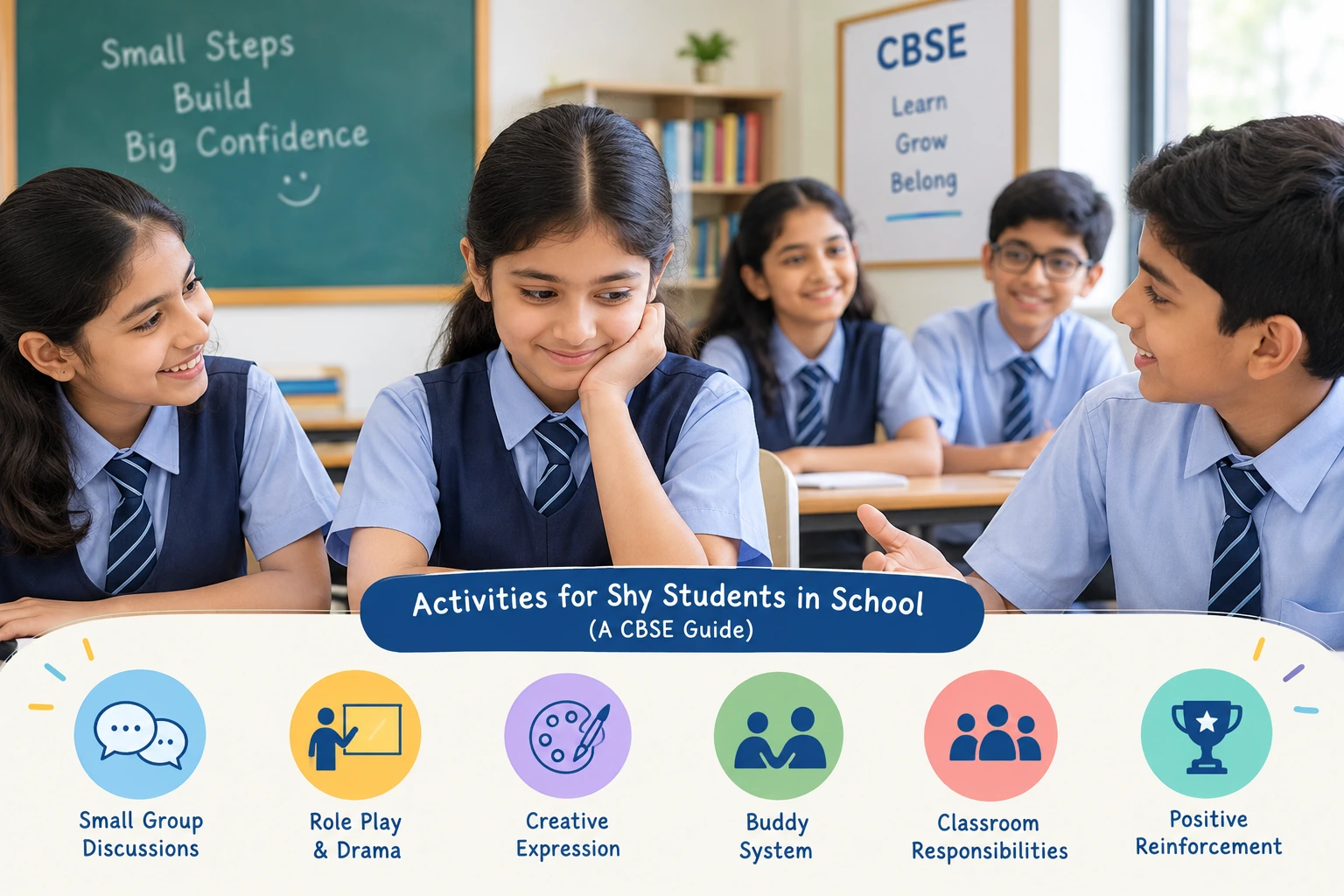
The best activities for shy students in school do not depend on speaking before the whole class. Pair work, small-group roles, hands-on projects, art and interest-based clubs let a quiet child take part at their own pace. Prepare students before they speak, value effort over volume, and confidence follows repeated safe experiences.
Picture a Class 7 student who writes the best answer in the room and never says it aloud. Her teacher sees a gap, her parents see shyness, and she sees the safest option. Student participation in CBSE schools is often judged by who speaks, which misses children who contribute in other ways. Shy does not mean lacking ability, creativity or leadership. It means the usual door, a raised hand, is the hardest one to use. Here is how schools can open other doors and conduct activities for shy students
Why Do Some Students Hesitate to Participate in School?
Hesitation rarely has one cause. Four turn up again and again.
- Fear of being wrong. A wrong answer in front of thirty classmates feels permanent, so silence feels safer than a guess.
- Nerves about speaking. The body reacts before the mind does: a dry mouth, a shaky voice, a blank.
- Fear of judgement. Being laughed at once, or compared with a sibling or a topper, teaches a child to stay out of sight.
- A new setting. A new class or school takes time, and children who chatter at home can go quiet for weeks.
Quiet is not the same as low confidence. Some children think before they speak, prefer writing to talking or simply do not enjoy a noisy room, yet are sure of how they work. Labelling them “weak” does more harm than the silence.
Some shyness does need attention. Nyborg, Mjelve, Edwards and Crozier (International Journal of Inclusive Education, 2020) note that shy children may trail peers in attainment and may be at risk of social anxiety disorder. Teachers and parents cannot diagnose that. If a child’s fear is intense and lasts for months, or it affects sleep or attendance, the school counsellor or the child’s doctor is the right next step.
7 Practical Activities for Shy Students in CBSE Schools
CBSE schools already have room to do this. NEP 2020 (paragraph 4.6) calls for experiential learning at every stage, including hands-on, arts-integrated and sports-integrated approaches. CBSE circular Acad 33/2020 asks for art-integrated projects done in groups of four to five students and states that artistic skill is not an evaluation criterion. The seven activities for shy students is listed below fit inside that frame.
1. Start With Pair Activities and Small Groups
Talking to one partner costs far less than talking to thirty people. Think-pair-share, credited to Frank Lyman of the University of Maryland in 1981, gives each child a minute to think, a partner to try the answer on, and only then the room. Give every group member a clear job: reader, recorder, materials manager or reporter. Bright Horizon’s guide to group learning formats covers team tasks in more depth.
2. Encourage Participation Without Forcing Public Speaking
Offer other routes to the same learning goal: a written answer, a labelled drawing, a model or a recorded presentation the teacher plays back. Share the question a day ahead where possible. A child who has rehearsed an answer at home will often volunteer it, and one volunteered answer is worth more than a hundred forced ones.
3. Introduce Classroom Responsibilities
Handing out notebooks, running the lab kit, updating the notice board or tidying the reading corner gives a child a reason to be seen and spoken to, with a task as cover. Rotate roles every fortnight so nobody is labelled and everybody gets a turn.
4. Create Opportunities Through School Clubs
A club is a room full of people who already like the same thing, which lowers the cost of speaking. Children who stay silent in class often talk freely once the topic is a puzzle or a painting. Let a child sample two or three before settling, and do not send a quiet child to the debate club first. Bright Horizon’s earlier piece on how school clubs reveal interests explains how repeated attendance shows what a child enjoys.
5. Use Creative and Hands-On Learning Activities
Model-making, experiments, storytelling, craftwork and project work give a child something to point at while explaining. The model carries the attention, so the child does not have to. Arts-integrated projects follow the same logic: the artwork is the evidence of learning. See how lab experiments connect to textbook concepts at Bright Horizon.
6. Recognise Effort, Not Just Achievement
Praise the first question asked, the idea shared in a group, the answer attempted. Do not rank children in public or reward only the loudest voice; that teaches quiet children that their way of taking part does not count. Name the act. “You raised the point about the circuit before anyone else did” works better than “good job”.
7. Build Trust Through Teacher Support
Participation grows where a child expects a calm response to a mistake. Teachers can learn what each child enjoys, hold short one-to-one conversations and give feedback that names one thing to keep and one to try next.
Pauses help too. Mary Budd Rowe’s classroom research on wait time (Journal of Teacher Education, 1986) found that when teachers waited three seconds or more, student answers grew longer and fewer students failed to respond. Give children time to adjust, and seek help if distress persists.
Activities for Shy Students in School That Build Confidence
Confidence-building activities for shy students work when they stack small wins in settings where the audience is small and the task is clear. The table sorts common school activities by how much speaking they need and which children they suit.
| Activity | Speaking load | Suits children who | What it builds |
| Pair reading and storytelling | Low | Like books and one trusted friend | Fluency and listening |
| Small-group experiments and projects | Low to medium | Think by doing | Explaining ideas, owning a role |
| Art, music, craft, creative writing | None to low | Express ideas better through making | Self-expression, pride in work |
| Quiz and team problem-solving | Medium | Enjoy puzzles and facts | Quick thinking with team support |
| Coding, maths and science clubs | Low | Enjoy logic and building | Peer talk around a shared task |
| Gardening, environmental and community projects | Low | Prefer action to talk | Responsibility and belonging |
Contribution has many forms, and none ranks above another. Bright Horizon International School’s Activities page lists a Speakers Club for debates, speeches and storytelling, a Mathematics Club, a Science and Innovation Club, a Dance Club, coding classes, art and craft, sports, and community service with peer-mentoring by senior students. A shy child need not begin with the Speakers Club; the quieter options give more ways in. Inclusive school activities work only when the child has a say, and activities to build student confidence fail when handed out as a cure. Sampling comes first.
How Teachers Can Make Classrooms More Inclusive
Ground rules come first. Set expectations for respectful listening, step in on teasing at once, and measure each child against their own last term, never against a classmate. One laugh can end a child’s participation for a month.
Purpose matters as much as comfort. In interviews with teachers experienced in working with shy children, Nyborg and colleagues found that teachers attended closely to how children felt but gave little thought to the learning purpose of oral tasks, and argued that both are needed. A “reporter” role should mean explaining the group’s finding, not standing near the board.
A participation ladder keeps both in view. Move a child up a rung only when the current one feels easy.
| Rung | What the student does | What the teacher does |
| 1. Respond privately | Writes an answer, draws or builds a model | Reads it and replies in writing |
| 2. Share with one partner | Talks through the answer in a pair | Picks a patient partner |
| 3. Hold a group role | Note-taker, timekeeper or materials manager | Assigns the role and states the task |
| 4. Report for the group | Tells the class what the group found | Shares the question beforehand |
| 5. Choose to present | Volunteers or presents alone | Praises effort, not polish |
Admission Enquiry
Nursery to Class 10, with hostel facilities from Class 4. Tell us a little about your child and we will call you back.
Thank you. Your enquiry has been received.
A member of our admissions team will call you shortly. If you need us sooner, call +91 89707 97028 or message us on WhatsApp.
How Parents Can Support Shy Children and Choose the Right CBSE School
How can parents help a shy child at home?
- Ask about interests and let the child finish a sentence without correction.
- Rehearse a short answer or presentation at home, with you as the audience.
- Arrange time with one or two familiar classmates.
- Praise effort and progress, not instant confidence, and avoid calling the child shy in front of others.
- Tell the teacher what works at home and ask what the teacher sees in class.
A child settling into a new class may need extra time; Bright Horizon’s guide to helping a child adjust to a new school has practical steps.
What should parents look for in a CBSE school?
- More than one way to take part: written, paired and group work, not just hands-up answers.
- Clubs a child can try before choosing.
- Teachers who pause after a question and avoid cold-calling.
- Recognition for effort, not just for toppers.
- A named teacher or counsellor to approach if a child struggles.
Visit and ask. Bright Horizon International School is CBSE-affiliated, teaches Nursery to Class 10 at Karimanelu, Venur, near Moodbidri, and runs the clubs on its Activities page; parents can ask how a quiet child is introduced to them. Its guide to extracurricular activities and student development explains how activities fit alongside academics.
Every Student Deserves a Chance to Participate
Confidence grows from experiences that go well, repeated. A shy child is not behind; the child is waiting for a way in that fits. Schools that offer pairs, roles, making, clubs and patient teachers count every contribution, not just the loudest, and that is what real student participation in CBSE schools looks like. Speaking on a stage is one skill among many, and it can be learned later, on the child’s terms, from a position of strength.
Contact Bright Horizon International School to ask how its activities work for your child, or call +91 89707 97028.
Frequently Asked Questions
How can teachers encourage shy students to participate in class?
Lower the cost of speaking. Start with pairs and small groups, share questions a day ahead, pause for three seconds or more after asking, and accept written or visual answers. Give each child a clear role and praise specific effort. Move to whole-class speaking only when the child is ready.
Which school activities for shy students are suitable?
Pair reading, small-group experiments, art and craft, creative writing, coding and maths clubs, quiz teams, and gardening or community projects suit quieter children, because the task holds attention instead of the audience. Let the child sample two or three, then keep the one they return to.
How can school clubs improve student confidence?
A club gathers children around a shared interest, so conversation starts with something to talk about. Regular attendance builds familiarity, small roles build responsibility and visible progress builds pride. Confidence comes from repeated, low-risk successes, and a club that fits the child supplies many of them. It is not a quick fix.
Should shy students be encouraged to participate in public speaking?
Encouraged, yes; forced, no. Build up in steps: a private written answer, pair talk, a group role, reporting for the group, then presenting by choice. Preparation and a topic the child cares about make speaking far less daunting. Fear that is intense and lasts for months needs a counsellor or doctor, not more pressure.
How can parents help shy children become more confident at school?
Listen without hurrying, rehearse short answers at home, arrange time with a familiar classmate and praise effort. Avoid calling the child shy in front of others. Share what works at home with the teacher and ask what the teacher sees in class. If worry is intense and persistent, speak to the school counsellor or the child’s doctor.
General educational guidance only. It is not medical advice and does not diagnose any learning or emotional condition. If you are concerned about a child’s wellbeing, consult a qualified professional.
About the Author
- Dr. Sharath Gore is the Founder and Chairman of Bright Horizon International School, Karimanelu, Venur, Dakshina Kannada. The school’s website describes him as an educationist and Karnataka Shikshana Ratna awardee, and his message says the school’s focus extends beyond academics to confidence, values, curiosity and courage. Chairman’s message
- Reviewed by L K Monu Borkala, a digital marketing strategist with 20+ years of SEO experience and over 650 client campaigns across India and UAE. As a founding member of OneCity Technologies, Bangalore, he oversees content strategy, editorial compliance and SEO frameworks across education, business services and digital marketing verticals.